




News
How to clean a Comek multihead weigher? A guide to dismantling and washing the product-contact components of the weigher.

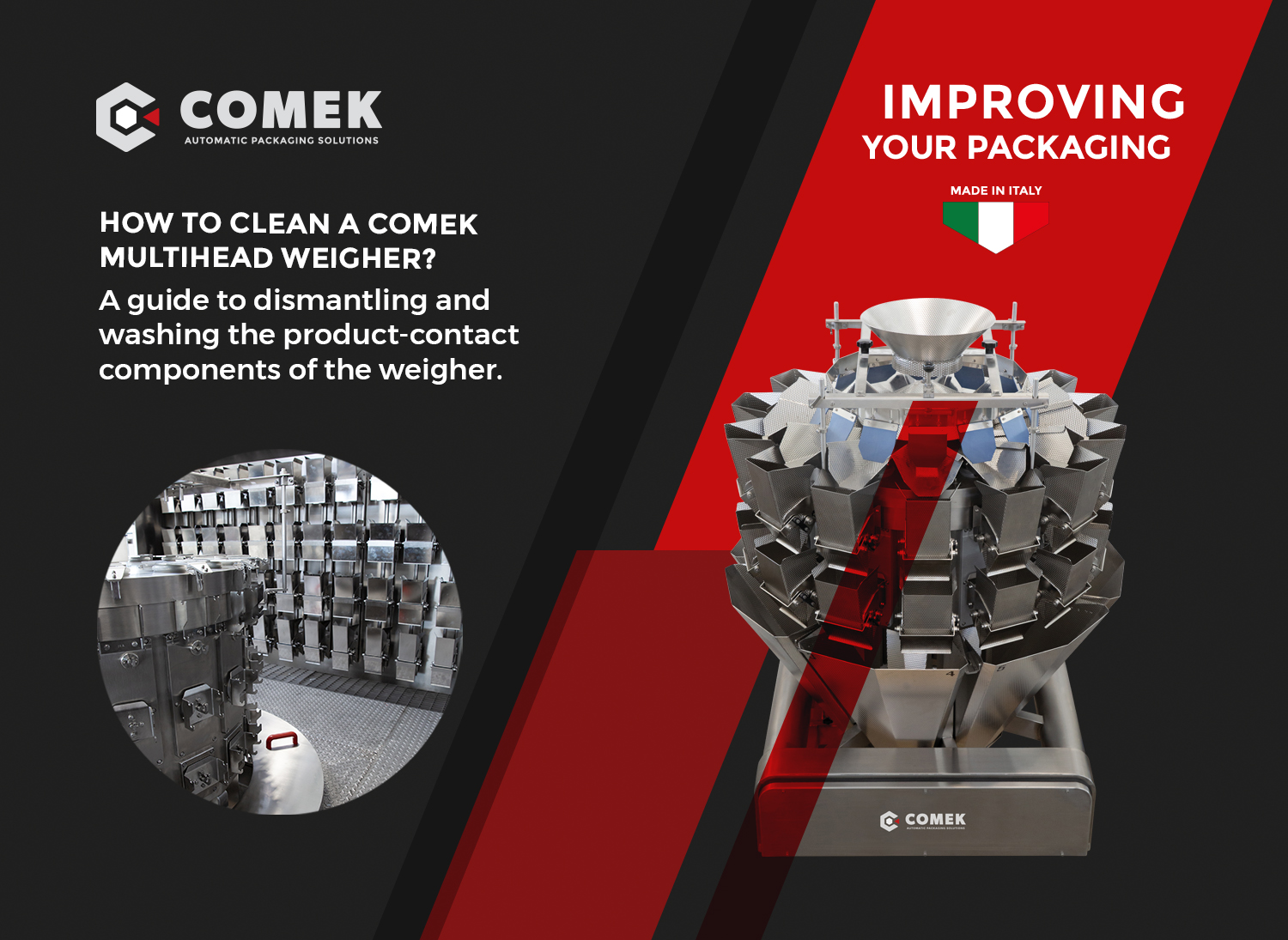
In the food industry, cleaning multihead weighers is essential to ensuring high hygiene standards, preserving product quality and maintaining an efficient production process.
However, washing and sanitation operations can be time-consuming, especially when components that come into contact with the product are difficult to access or remove.
For this reason, Comek multihead weighers are designed to simplify cleaning and maintenance operations through construction solutions that facilitate accessibility, quick disassembly and thorough washing of all food-contact parts.
Let’s take a closer look at how the components are disassembled and which design features make cleaning operations simpler and more efficient.
Multihead weighers designed to make cleaning easier
The efficiency of a multihead weigher does not depend solely on weighing accuracy and speed. Ease of cleaning is also a key factor, particularly in food production environments where frequent washing is required.
Comek multihead weighers feature a frame and main body made of AISI 304 stainless steel and an open-frame design with rounded surfaces, developed to ensure easy accessibility and limit the accumulation of product residues.
Another important advantage is the possibility of easily removing components that come into contact with the product, allowing thorough washing even of the least accessible surfaces.
The entire design is focused on simplifying operators’ work, reducing the complexity of cleaning operations and helping ensure greater production continuity.
How to disassemble a Comek multihead weigher for washing
The disassembly procedure involves several components of the weigher, from the product collection area to the feeding and conveying systems.
Let’s look at the main steps included in the Comek procedure.
1. Removing the buckets and chutes
The first step involves removing the pre-weighing and weighing buckets, which are placed on the dedicated washing wall.
The doors remain open, allowing easier access to the internal surfaces and ensuring thorough cleaning.
The chutes are then removed and placed on the washing wall to allow for thorough cleaning.
2. Installing the safety guards and removing the cones
Before proceeding with disassembly, anti-fall safety guards are positioned on the floor to ensure operator safety during cleaning and maintenance activities.
The product distribution cone is then removed, followed by the central vibrating cone, which is disassembled using the dedicated tool supplied with the machine.
Both components are placed on the washing wall, where they can be cleaned more easily and thoroughly.
3. Quick-release removal of the radial vibrating channels
The next step involves the radial vibrating channels, which can be removed using a quick-release system.
These components are also placed on the dedicated washing wall, simplifying cleaning operations and providing easier access to all product-contact surfaces.
The washing walls are one of the distinctive features of Comek’s solution. They are designed to hold the components in an open position, facilitating access to the different surfaces and allowing more thorough cleaning.
4. Removing the product braking device and the Easy Clean belt
The product braking device is then removed, followed by the disassembly of the Easy Clean connecting belt.
To remove the belt, the hopper and scraper must first be taken off. The quick-release system can then be activated to extract the belt for cleaning.
Once again, the components are designed to make disassembly easier and provide convenient access to the parts that need to be washed.
5. Reassembling the components
Once washing has been completed and any checks required by company procedures have been carried out, the components can be reassembled.
To make this stage simpler and more organised, each component is marked with an identification number, allowing operators to identify its correct position.
This design feature makes operators’ work easier and helps speed up the reassembly process.
Easier cleaning, greater production efficiency
The easy disassembly of Comek multihead weighers is the result of specific design choices: accessible and removable components, quick-release systems, dedicated washing walls and clearly identified parts.
These features offer tangible benefits to food manufacturers:
- More thorough cleaning, thanks to easy access to all product-contact surfaces.
- Simpler operations, through disassembly systems designed to make operators’ work easier.
- Greater safety, thanks to the use of protective devices during cleaning and maintenance activities.
- Easier reassembly, with identified components that help ensure correct positioning.
- Reduced machine downtime, thanks to more manageable cleaning and maintenance operations.
The goal is to make cleaning and maintenance easier to integrate into everyday production management, without overlooking the hygiene and safety requirements of the food industry.
Comek multihead weighers: hygiene built into the design
In food packaging, every design detail can make a difference.
Comek multihead weighers combine weighing technology with design solutions specifically developed to facilitate cleaning, meeting the needs of production processes that require high hygiene standards and operational continuity.
Discover all the features of Comek multihead weighers.